
(This essay was awarded the 2022 Smith Publicity Book Marketing Scholarship. View Smith Publicity’s announcement and our conversation together here.)
One of the things I see my generation struggling with the most is remaining hopeful in the face of seemingly hopeless times. We are constantly bombarded with images of war, disaster, unrest, and suffering. It seems like the only respite is dissonance, but that comes with its own guilty weight. It feels impossible to be educated, happy, aware, healthy, active, ethical, financially stable, and sane all at the same time. That’s why Allison Cobb’s eye opening Plastic: An Autobiography comes like a sigh of relief — and a punch to the gut.
This book is a complex and provoking mesh of memoir, textbook, biography, and poetry which for the sake of simplicity we will just call a book. It begins with Cobb’s discovery of a large, black, plastic car part discarded as trash along the sidewalk. In a sense, however, the book also begins with a photograph of a dead albatross, its stomach spilling out plastic. It begins with a math student who would one day help to invent the atomic bomb; with a war, a soldier, and a plane crashing in the Pacific. It begins with the color purple and a chemist in London and benzene and a snake swallowing its own tail.
Plastic follows these various, seemingly unrelated storylines, revealing fractions of them a bit at a time with the connections between each not always clear at first. Through these lenses, Cobb explores heavy themes such as warfare, greed, familial strife, apology, and global destruction. Miracuously, however, the book never becomes too convoluted. Cobb lays out these complex stories in an understandable way. One does not need to be a chemist to understand the creation of benzene and the chain reaction that led to cellophane and faux ferns. Furthermore, despite the heaviness and sorrow of its themes, a reader does not leave this book feeling dejected. Cobb doesn’t wear kid-gloves, and she doesn’t try to sugarcoat the extremity and enormity of the danger our planet faces, but she still manages to instill a sense of hope into her audience.
It is no wonder that Cobb is able to so artfully strike the balance between hope and fear; it’s literally her job, something which she addresses directly in the book. Cobb is a writer for an environmentalist organization, which in her words means her task is “to make others feel sorrow and concern, but not despair.” One certainly may (and should) feel a sense of sorrow reading about the havoc wreaked by plastic and greed on our planet, but the book never hesitates to provide comfort in the form of action. Many chapters depict clean-up efforts, but these sections never come off as didactic or idealistic. Cobb focuses largely on the sense of community that comes with these efforts, the joined pain and outrage. She highlights the pride of taking action but also the fear that it’s all for naught. In this way, readers who struggle with the same mix of feelings, which I would venture are many of us, feel seen and understood.
Cobb’s choice to interweave these stories works on a number of levels. Primarily, it is a brilliant way to keep readers engaged. Early on, we are given the sense that every little detail will play a larger role than we can expect. This gives the book momentum, as reading becomes an exercise to uncover meaning and truth and clarity within the pages. This style is also a great way to engage readers across different disciplines and interests. Each reader can develop their own interpretation or understanding of the book with their unique perspective on the various themes and topics. The careful balance of science, history, etymology, mythology, and poetry provides something for every reader to engage with, and once we are drawn in by one of these themes it becomes impossible not to appreciate and understand all.
This interwoven structure of storytelling not only keeps readers engaged; it also teaches them a very unique and powerful way of looking at the world. It encourages readers to see the strings that bind together history, the chain reactions and minute decisions and unintended consequences that have created the world as we know it. This critical eye can help a person to understand the world, their society, and themselves better and to be more mindful in making choices as a result.
When one sees pictures of a plastic island twice the size of Texas in the middle of the ocean, it’s overwhelming. The mind spins at the sheer magnitude of it, at the racing questions of how did we get here, how did we let this happen, my god, is there anything we can do? Cobb artfully unweaves this issue over the course of the book by examining the issue of plastic consumption from various points of view. She details the chemical history of plastic’s creation, including the many early stages and accidental discoveries; she also looks at the issue of plastic consumption from an economic perspective, exploring the history of advertising and the relationship between plastic and capitalism. Beyond that, she examines how the invention of plastic contributed to the production of military weapons and the eventual development of the atomic bomb.
By breaking down this issue into its parts, showing the individual actions and decisions and desires at each step, the situation becomes less frightening, albeit no less serious. It’s still bad, of course, the world’s in the gutter, but this book shines a little light on the fear. As its title would suggest, the book makes plastic knowable to us, understandable. In this sense, it also seems more solvable. This method of approaching problems can be utilized by readers in any arena of their lives. It is in this way that Plastic achieves its hope amongst its sorrow. By pointing out the individual actions that created the problem, Cobb instills hope that individual actions can create the solution as well. Cobb is clear that the bulk of responsibility for plastic overconsumption — and the bulk of responsibility for solving the issue — lies mainly on the shoulders of corporations and legislators who have neglected and abused this planet for monetary gain. The fact that plastic consumption, like global warming and most other societal issues, is systemically supported by powerful institutions can be rattling and make already overwhelming problems seem that much more indomitable. Cobb reminds us, however, that individual action can lead to large-scale change. She assures us that individual efforts are not wasted time and that we are united by stewardship and love for our planet. Cobb’s intriguing technique of telling a story through its many scattered parts teaches readers to look at problems, however large or small they may be, as parts of a whole and to solve them the same way you pick up plastic off a beach: one piece at a time.
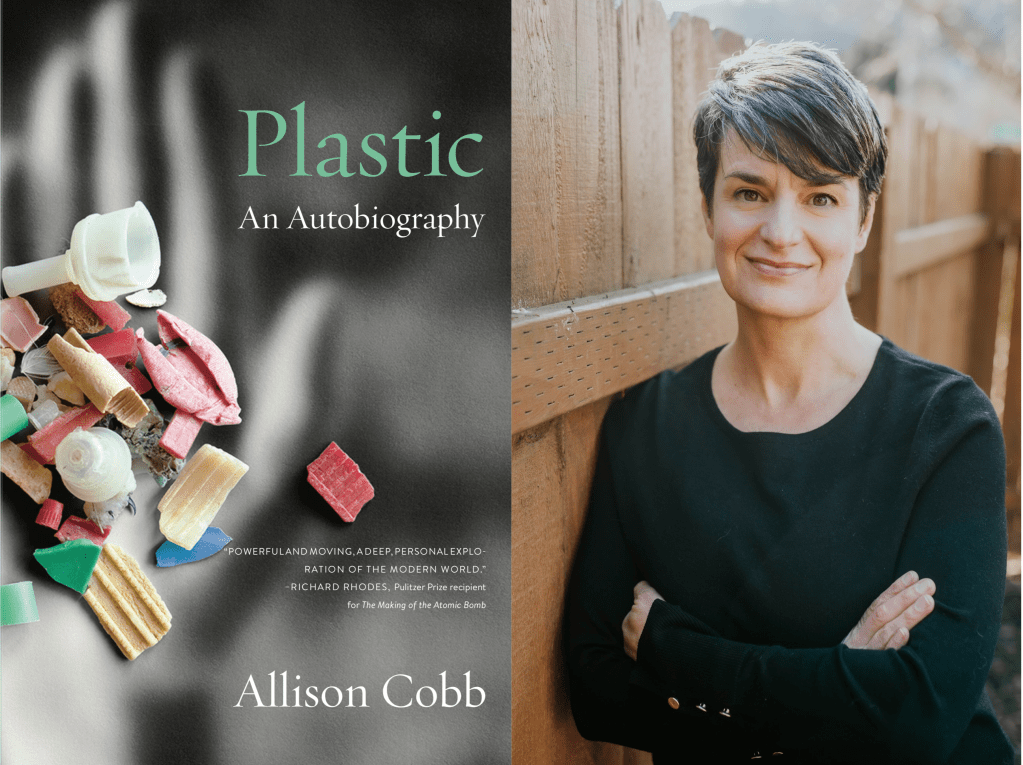
Plastic: An Autobiography was authored by Alison Cobb (pictured) and published by Nightboat Books in 2021.
 Eve Annajane Writes, LLC